

Diffraction Beam press notes
Practical press notes for getting Diffraction Beam to register cleanly and release evenly. Use these checks on labels, seals and narrow web work before you run.
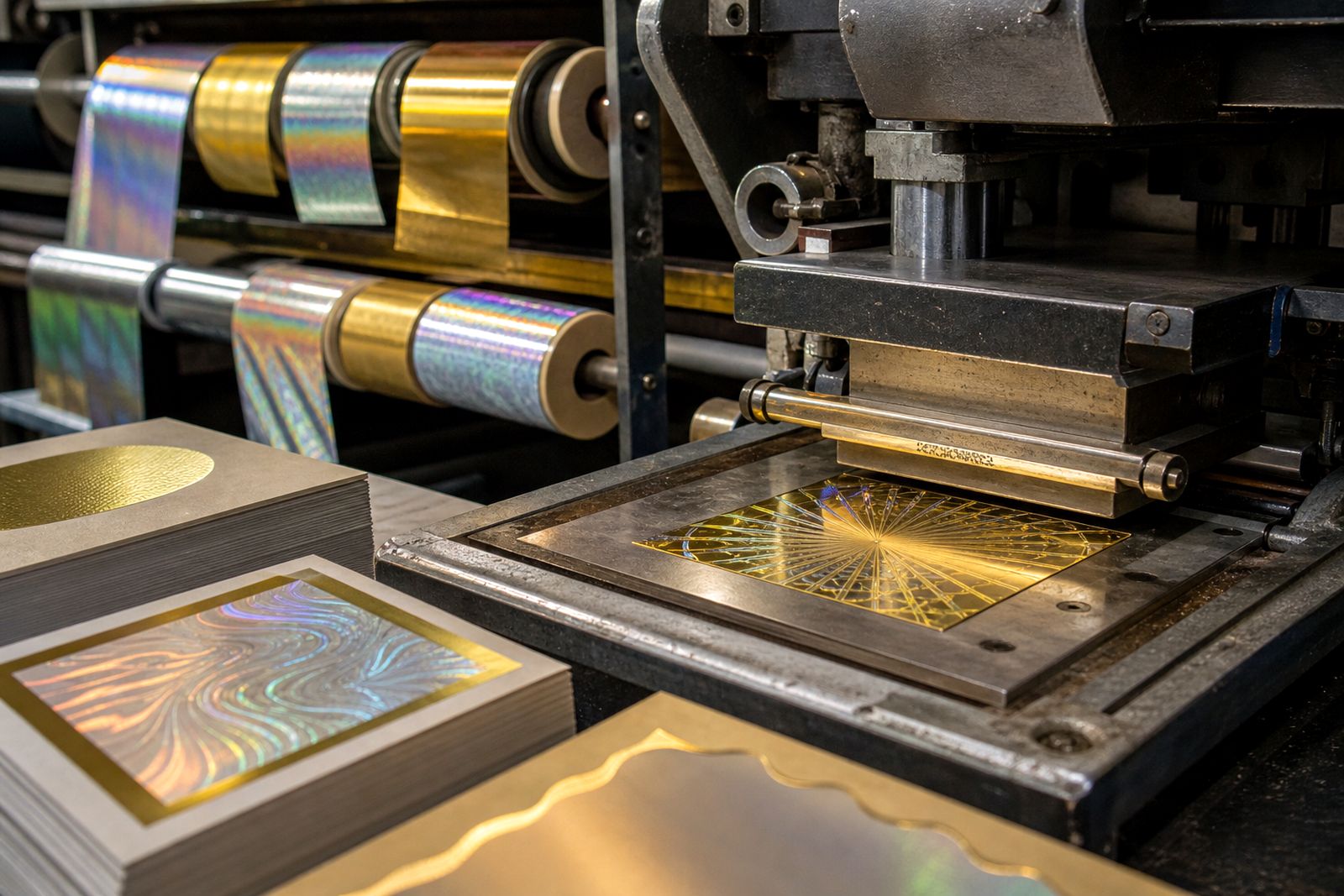
What this foil is for
Diffraction Beam is a diffraction foil family used where a bright patterned finish and tight register matter. It suits narrow web work such as beverage labels, pharma seals and serial strips, especially where the foil needs to sit cleanly on fine detail.
The family is supplied as narrow rolls slit to width for the job, with swatch books and samples available to help match the visual effect before press set-up. For broader product details, see Diffraction Beam Specifications or move back to Diffraction Beam.
Substrates and presses
This foil is commonly checked on coated board, label stock, soft-touch laminate and other smooth surfaces where diffraction detail must transfer cleanly. As with any foil family, the surface, coating and ink system all affect release and adhesion, so make-ready should begin with the actual stock, not a lookalike.
Diffraction Beam can be run on platen, cylinder and roll-to-roll presses when the press, die and web handling are set up for the substrate. If you are planning a run across different materials, review the substrate guidance in the Diffraction Beam Substrates.
| Press note | What to check |
|---|---|
| Web control | Keep the narrow roll tracking steady so the diffraction pattern stays in register. |
| Stock surface | Confirm the release behaviour on the final coating, laminate or print finish. |
| Make-ready | Test the foil on the real die, not only on a flat sample. |
Make-ready checks
Start with a sensible temperature window for the substrate and die combination, then test dwell, pressure and release in small steps. The aim is even transfer without crushing the pattern or starving the image.
Check the foil face, the backer and the die after each pull. If the image looks dull, broken or uneven, adjust one variable at a time so you can see whether the change came from heat, dwell, pressure or release profile.
- Temperature use a test window that suits the stock and adhesive layer.
- Dwell keep it long enough for full transfer, but not so long that the pattern blurs.
- Pressure apply enough force for clean contact across the die face.
- Release check that the foil releases cleanly from the non-image areas.
Dies and packing
Die choice matters. Magnesium, copper and brass each behave differently in heat transfer, detail retention and wear, so the die should match the artwork, run length and press type. Fine diffraction detail usually needs a die that is flat, clean and well maintained.
Packing and pressure are just as important as the die metal. Too much packing can push foil into the wrong areas, while too little can leave weak transfer or patchy fill. Use enough packing to support the image area evenly and keep the die face true across the sheet or web.
For ordering and roll configuration guidance, see Order Diffraction Beam.
Common faults and fixes
Most press faults with diffraction foil come down to make-ready rather than the foil itself. If you see fill-in, flaking, poor adhesion or feathering, work through the press conditions in order and change only one thing at a time.
- Fill-in reduce pressure, review packing and check the die edge condition.
- Flaking test a wider temperature window and confirm the stock surface is suitable.
- Poor adhesion increase dwell carefully and check substrate coating or laminate release.
- Feathering reduce heat spread, verify die sharpness and look at web tension or sheet movement.
If you need help matching the setup to the job, use the contact form and ask for press-side advice.
What our Hot Stamping Foil customers say
Verified Google reviews
Also worth a look
Ask about a foil for your job
Send a note through our contact form with the substrate, the press you run (platen, cylinder or roll-to-roll), the finish you are after and the run length, and we will come back with a foil grade, a sample and a quote.
Open the contact form