

Diffraction Beam specifications
Use these starting points to test Diffraction Beam on your stock and press. Check the substrate, make-ready and press settings before production.
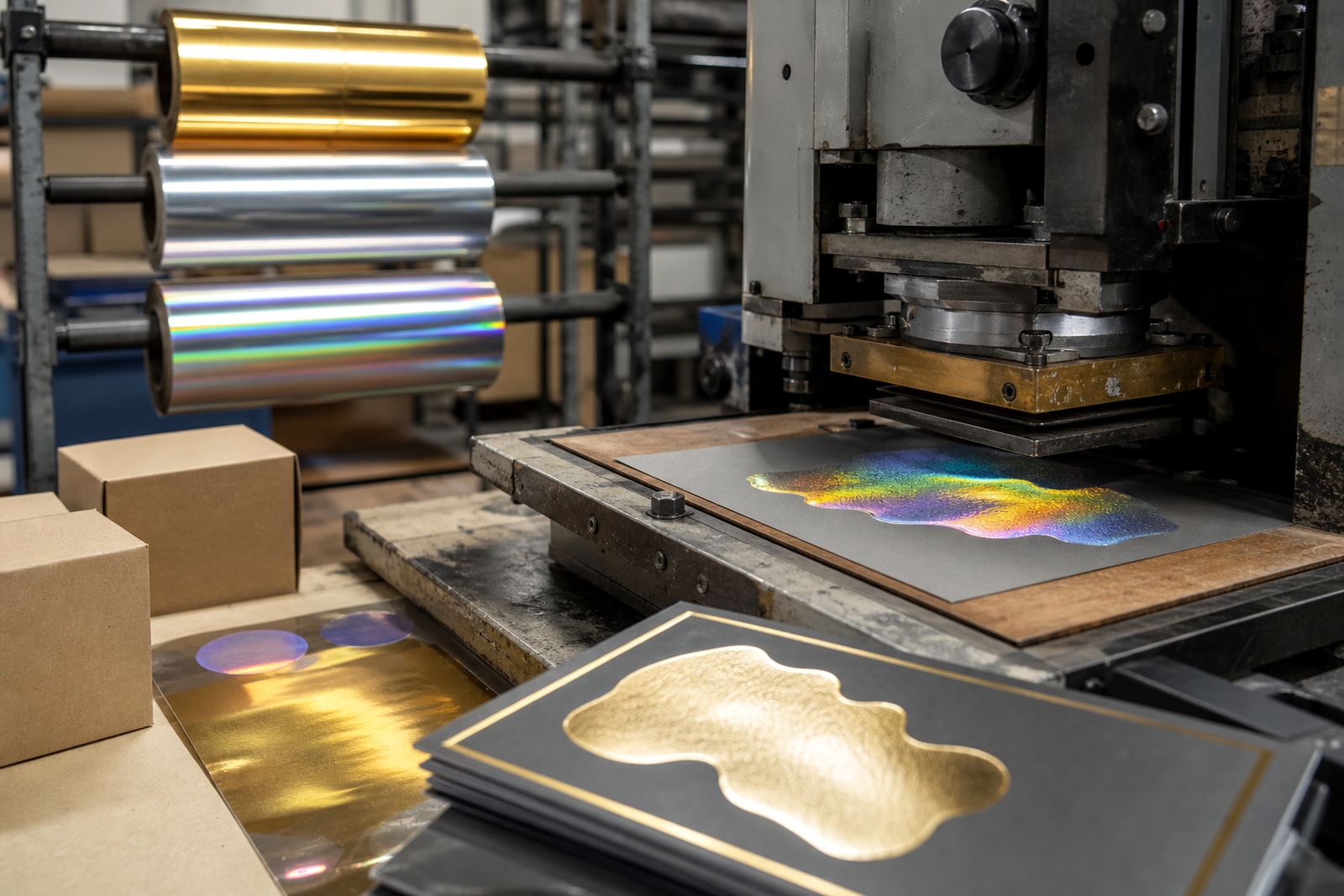
What this foil does
Diffraction Beam is a diffraction foil family used where a strong patterned light effect is needed on labels, seals and strip work. It is commonly specified for work that needs a clean visual shift rather than a flat metallic look.
The product is suited to beverage labels, pharma seals and serial strips, where the pattern lock and narrow roll supply help keep work controlled on press. For substrate checks and application notes, see Diffraction Beam substrates.
- Pattern lock for a defined diffraction appearance
- Narrow rolls for narrow web and strip work
- Registrable for repeatable placement on set-up work
Starting points to test
Use these as starting points only, then adjust on your own stock and press. The right result depends on substrate, artwork, die condition and make-ready.
| Specification | Starting point |
|---|---|
| Temperature window | Test from 95 to 125°C |
| Dwell | Test from 0.4 to 0.8 seconds |
| Pressure | Use enough pressure for full transfer without crushing the pattern |
| Release profile | Test a clean release with no smearing, picking or partial transfer |
If the image breaks up, check heat, dwell and pressure before making any other changes. For press-side guidance, see Diffraction Beam press notes.
Substrates and presses
This foil is intended for common label and strip substrates where a diffraction effect can register clearly. On coated board, films and laminate systems, check the surface feel and the finish before production. On soft-touch laminate, test carefully because release behaviour can change with surface texture.
It can be trialled on platen, cylinder and roll-to-roll presses, provided the die, pressure and web route are set correctly. On narrow work, keep the web running true and check that the artwork sits within the usable area of the roll.
- Platen presses for short-run and set-up work
- Cylinder presses for repeat work
- Roll-to-roll presses for narrow web applications
How it is supplied
Diffraction Beam is slit to the roll width you need for the job. That helps keep waste down and makes it easier to match the press and the web route. No stock numbers are stated here, so confirm the width required for your job through the contact form.
Swatch books and samples can be used before production so you can check pattern clarity, release and registration on your own stock. If you need a supply check or a width that suits your press, use the contact form to request a quote.
- Slit to width for the job
- Supplied for testing before production
- Suitable for narrow roll handling
Set up and test
Before running full quantity, test on the actual stock, with the final die, ink and press settings in place. Check the make-ready in this order: temperature window, dwell, pressure and release profile. Then run a short proof to confirm pattern lock, transfer and registration.
If you are unsure whether the substrate is suitable, compare it with the related notes and ordering steps. You can review Diffraction Beam on Diffraction Beam and place a request through Order Diffraction Beam. For broader foil options, see Products.
For trade use, the safest approach is always a small press test on your own stock before committing to production.
What our Hot Stamping Foil customers say
Verified Google reviews
Also worth a look
Ask about a foil for your job
Send a note through our contact form with the substrate, the press you run (platen, cylinder or roll-to-roll), the finish you are after and the run length, and we will come back with a foil grade, a sample and a quote.
Open the contact form