

Spirit neck labels
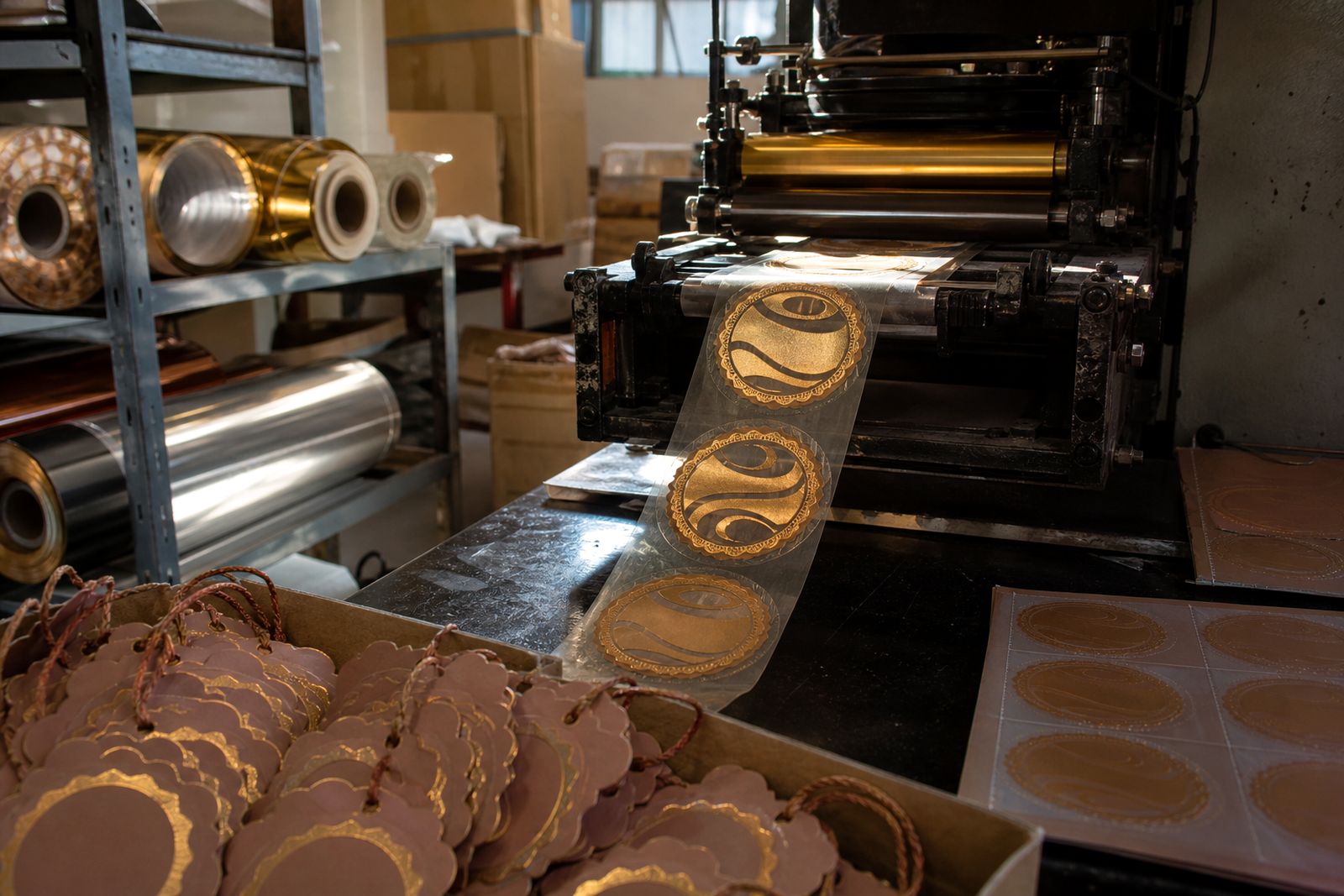
A shaped pressure sensitive label job with bronze cord detail, set up for clean stamping on narrow label stock. The run focused on foil choice, die fit and steady release on press.
Job brief
The work was a label set with a bronze cord look carried across shaped pressure sensitive labels. The aim was to keep the finish neat on a small format while holding a clear edge on the shape and a clean foil image on the face.
For this kind of label work, the important points are the stock, the adhesive system, the die detail and how the foil releases on a short image area. On shaped labels, small changes in make-ready can affect bite, edge sharpness and how evenly the image lays down.
Project notes and foil products are useful starting points for similar work.
Foil choice
A bronze metallic foil was the natural fit for the cord effect. Bronze gives a warmer tone than gold or silver, and it suits label work where the finish needs to read as refined rather than bright. For shaped PS labels, metallic foils also need clean release so the image stays solid through tight detail.
Where a design needs variation, the same job can be tested against gold, copper or satin metallics, or against a pigment foil if the brief calls for a flat colour instead of shine. For special effects, holographic, diffraction or security foils can be added, but the foil has to match the stock and press conditions first.
See related applications such as Retail Gift Sleeves and Wine estate carton.
Tooling and setup
The die choice matters just as much as the foil. For shaped labels, a clean-cut magnesium, copper or brass die can help hold fine detail and keep the image consistent across the run. If the label has a cord line or narrow decorative band, the die face must support even pressure right through the detail.
Make-ready should check foil travel, nip, impression and the release profile before the run settles in. On pressure sensitive labels, the team will usually start with a test strip and then adjust dwell, pressure and temperature to find the working window. As a practical starting point, many metallic foils are tested in the lower to mid heat range and then tuned on press for the actual stock.
For setup advice on foil rolls slit to width, visit the contact form.
How it ran
On press, the aim was a steady transfer with no patching, scuffing or over burnishing. Narrow label work often needs careful control of feed and tension, especially when the image sits close to the die edge or when the release window is tight.
Platen, cylinder and roll-to-roll presses each need a slightly different approach, but the same checks apply: clean impression, correct substrate temperature, stable dwell and a release that does not pull back on fine detail. If the stock is coated or has a soft-touch laminate feel, the starting point is always a proper test rather than a fixed setting.
- Check foil laydown on the first sheet or web section
- Confirm edge sharpness on the shaped cut
- Watch for lifting on tight corners
- Adjust temperature and pressure in small steps
What to use on similar work
Spirit neck label work like this is a good fit for bronze, copper or satin metallic foil, depending on the tone needed. If the brief changes, pigment foils can give solid colour, while holographic or diffraction foils add movement. For brand protection or traceable features, security foils are also used in the same general production space.
Stampingfoil can supply slit rolls, swatch books and samples for label trials, plus press-side advice on adhesion, release and make-ready. For matching foil to labels, cartons, book covers, leather goods or other substrates, use the product pages and the contact form to ask for a quote.
| Good fit | Notes |
|---|---|
| Bronze metallic foil | Warm metal finish for shaped PS labels |
| Fine die detail | Helps hold the cord line and edge definition |
| Test strip setup | Useful before full production on narrow stock |
What our Hot Stamping Foil customers say
Verified Google reviews
Also worth a look
Ask about a foil for your job
Send a note through our contact form with the substrate, the press you run (platen, cylinder or roll-to-roll), the finish you are after and the run length, and we will come back with a foil grade, a sample and a quote.
Open the contact form