

Labels and stickers
Use foil finishes on labels, seals and decorative stickers that need sharp detail and clean release. Start with the right foil, die and press settings for the stock and laminate.
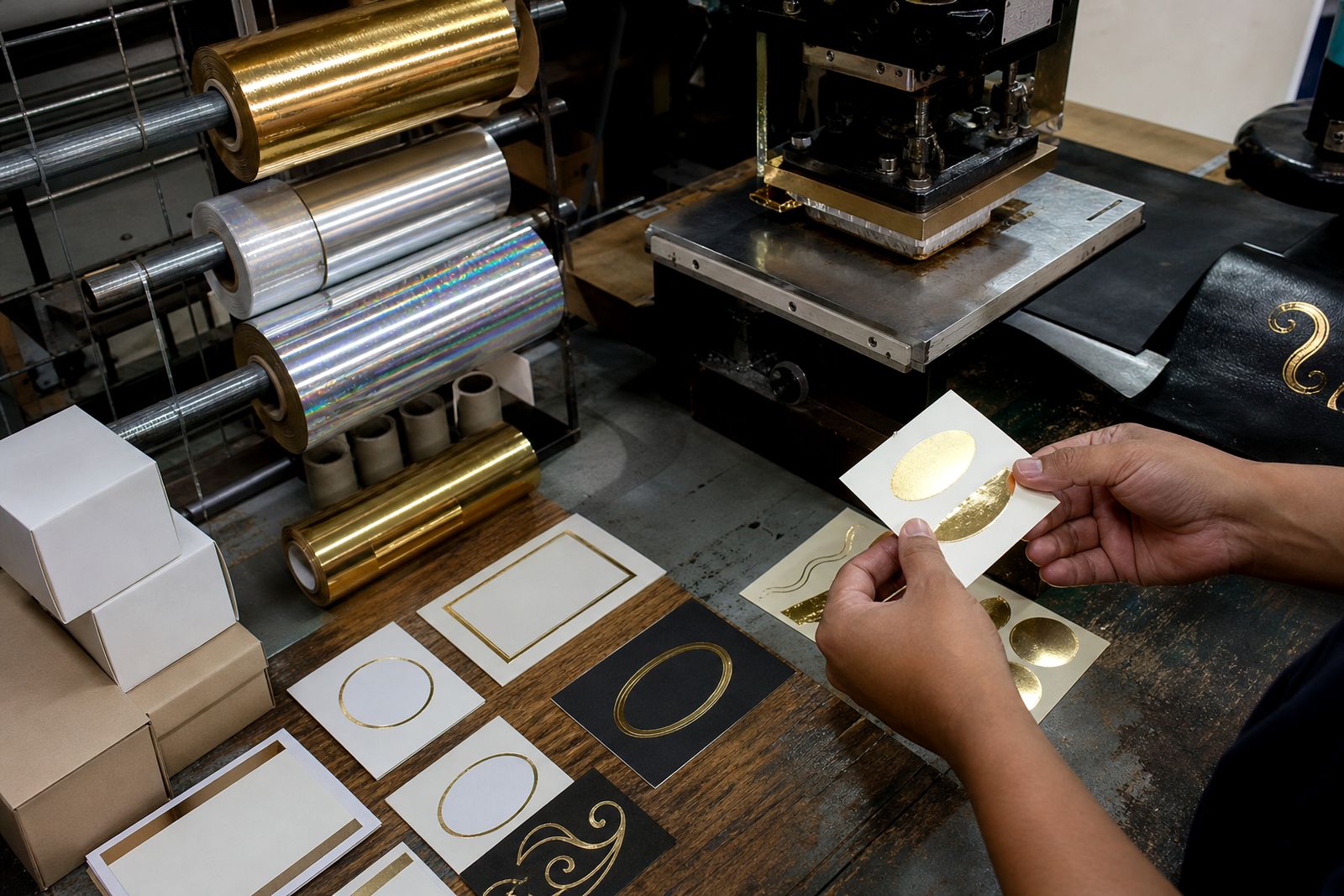
Foil choices
Labels and stickers often need a finish that stays crisp on small type, fine borders and repeated shapes. For that work, choose the foil family to suit the look and the stock.
- Metallic foils for gold, silver, copper, bronze, mirror and satin effects.
- Pigment foils for solid black, white and process colours.
- Holographic and diffraction foils for visual impact and pattern effects.
- Security foils for seals, tamper-evident looks and controlled applications.
- Specialty foils where labels are applied to plastics, soft-touch laminate or other challenging surfaces.
If the job includes fine lines or small copy, ask for swatch books or samples before you commit to the run. Matching the foil to the final use is usually the quickest way to avoid weak transfer or blocked detail.
Substrate checks
Before stamping, check whether the label stock is coated, uncoated, laminated or soft-touch. Each surface takes foil differently, especially on pressure-sensitive labels and decorative stickers that are later die-cut or kiss-cut.
On coated board and lacquered label stock, transfer is often cleaner, but over-polished or highly sealed surfaces can reduce grip. On soft-touch laminate, test carefully because the release point can be narrow and the foil may need a different combination of heat and pressure.
| Check | What to look for |
|---|---|
| Surface | Coated, uncoated, laminated or soft-touch finish |
| Shape | Fine type, solid blocks, reverse detail or tight registration |
| Cutting | Whether stamping is before or after die-cutting |
| Adhesion risk | Poor grip, patchy laydown or lifting at edges |
If the label will be handled often, test whether the foil sits well beside varnish, overprint and adhesive margins. For difficult substrates, start with small trials and adjust before full production.
Dies and setup
Die choice matters as much as foil choice. Magnesium, copper and brass dies each have their place, depending on detail, run length and heat transfer needs. Fine type and sharp logos usually need careful make-ready so the pressure lands evenly across the image.
On platen, cylinder and roll-to-roll presses, keep the tooling clean and the die face flat. Uneven mounting, dirty backing or poor register can cause ragged edges and weak corners on narrow labels and seals.
- Use the die material that suits the detail and the press.
- Check impression depth before moving to full sheets or web runs.
- Keep the foil route straight to avoid creasing on narrow artwork.
- Confirm release direction if the artwork includes lifts, borders or screened fills.
If you need guidance on die selection or make-ready, ask for press-side advice through the contact form.
Press settings
For labels and stickers, the starting point is to test a sensible temperature window, then adjust dwell and pressure until the foil releases cleanly. Typical starting ranges vary by foil type and substrate, so use samples rather than guessing on the full run.
A short dwell can help on smooth label stocks, while more textured or coated surfaces may need a little more time under pressure. Too much heat or pressure can blur fine detail, while too little can leave pinholes, skipping or incomplete solids.
Keep notes for each job on foil type, stock, die and press condition. That makes repeat work faster to set and easier to troubleshoot when the artwork changes.
Common faults
When foil does not behave on labels and stickers, the fault is usually in the setup, not the artwork. Start by checking the stock, the die, the foil route and the press settings in that order.
- Poor adhesion often points to the wrong foil for the stock, or too little heat, dwell or pressure.
- Ragged edges can come from uneven make-ready, blunt tooling or poor impression balance.
- Patchy release may mean the laminate, coating or soft-touch surface needs a different foil family.
- Blocking or scuffing can happen if the foil is transferred too hot or stacked before it has settled.
If you are comparing finishes for labels, seals, cartons or other branded work, see Packaging & Boxes, Security Finishes and Cosmetics Cartons. For foil supply, swatch books and a quote, use the contact form.
What our Hot Stamping Foil customers say
Verified Google reviews
Also worth a look

Ask about a foil for your job
Send a note through our contact form with the substrate, the press you run (platen, cylinder or roll-to-roll), the finish you are after and the run length, and we will come back with a foil grade, a sample and a quote.
Open the contact form