

Rainbow Holo
Rainbow Holo gives a lively shifting rainbow effect on the finished job. It needs sensible setup, the right stock and proper press checks to read cleanly.
What it looks like
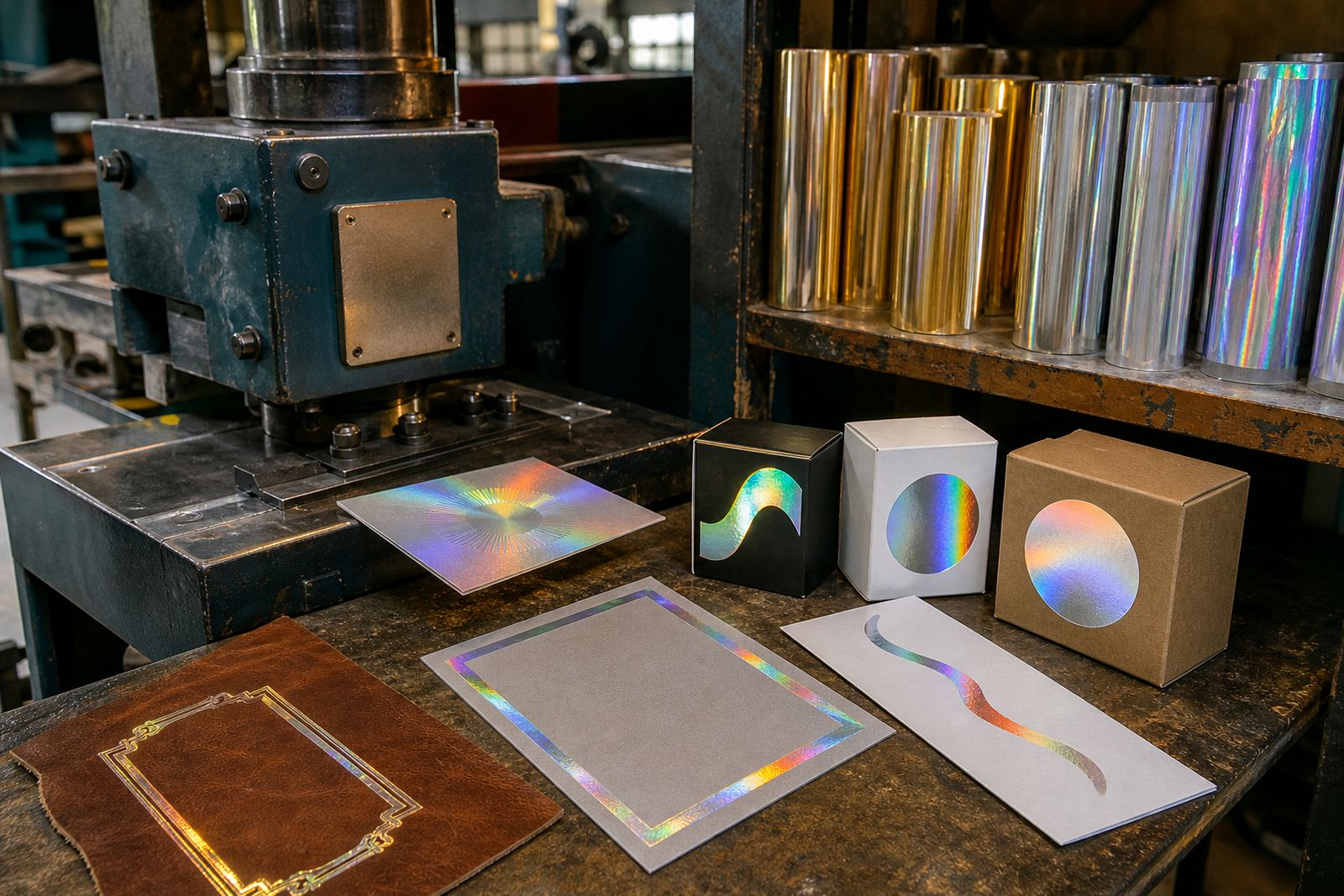
Rainbow Holo gives a bright diffraction finish with colour movement across the image as the sheet catches the light. On solid areas it reads as a strong rainbow sparkle, while finer artwork can show a more broken, prismatic effect depending on the design and die.
It is often chosen where the finish needs to stand out without relying on metallic gold or silver alone. For other reflective looks, compare it with Linear diffraction, Mirror silver and Bright gold.
Where it suits
This foil is commonly used on labels, cartons, book covers and other presentation work where a vivid decorative finish is wanted. It can also suit security style accents and promotional pieces where the holographic look forms part of the design.
Rainbow effects usually work well on smooth, coated stocks and on materials prepared for hot foil stamping. For softer or more specialist substrates, check against the job structure first, especially when working on labels, packaging or leather goods.
Substrates and surfaces for rainbow holo
Start by checking the stock surface. Smooth coated board, laminated board and clean synthetic surfaces generally give the most even appearance. Soft-touch laminate can be more sensitive and may need a careful make-ready and test area before running full sheets or reels.
For plastics and textiles, surface treatment and the final finish on the substrate matter as much as the foil itself. Keep the artwork and background simple where the rainbow effect must stay clear and readable.
| Stock | What to check |
|---|---|
| Coated board | Even release, clean image edges, no scuffing |
| Soft-touch laminate | Adhesion, pressure, release and surface sensitivity |
| Plastics and textiles | Surface prep, heat tolerance and dwell control |
| Leather | Grain, compression and die detail |
Press checks for rainbow holo
As with any holographic foil, the result depends on temperature, dwell, pressure and release. Use a practical starting point and test on the actual stock, then adjust until the image transfers cleanly without blur, pinholing or unwanted dulling.
Typical starting ranges should be tested on press rather than assumed. That matters on platen, cylinder and roll-to-roll machines, and it matters even more when the job uses fine text, narrow lines or dense coverage. If needed, ask for press-side advice through the contact form.
- Check die condition and make-ready before the first pull
- Confirm the foil release matches the stock and image area
- Test sheet speed against dwell and pressure
- Watch for overheat on delicate laminates and synthetic surfaces
Ordering and support for rainbow holo
Rainbow Holo can be supplied slit to roll width for the press setup you are running. Swatch books and samples are useful when comparing it with other finishes, especially if a customer is deciding between holographic sparkle and a more metallic look.
For stock matching, foils can be discussed alongside the die material, press type and substrate before the job starts. If you need help choosing between this finish and another option, see the finishes library or send the job details through contact form.
Related finishes to review include Copper bronze, Satin silver, Opaque white and Process blue.
What our Hot Stamping Foil customers say
Verified Google reviews
Also worth a look
Ask about a foil for your job
Send a note through our contact form with the substrate, the press you run (platen, cylinder or roll-to-roll), the finish you are after and the run length, and we will come back with a foil grade, a sample and a quote.
Open the contact form